When a Cat Will Not Drink Enough Water
Most cats do not drink enough water, and it is not a training problem. Cats descend from desert animals and evolved to take most of their water from prey, so a low thirst drive is normal equipment rather than a fault. That means the reliable fix is almost never persuading the cat to drink more, it is putting more water into the food and making the water that is out easier to reach. Here is the order those changes actually mattered for three cats in a Palm Springs house, including the one that did the most and the one that gets recommended most.
Some links below are affiliate or referral links. We earn a small commission at no cost to you. We only recommend what we actually use for Bandita, Whitey, and Shempy. As an Amazon Associate we earn from qualifying purchases.
A note before anything else. We are not veterinarians. A cat that suddenly stops drinking, stops urinating, strains in the litter box, or seems lethargic needs a vet, not an article. Dehydration and urinary blockages move fast in cats, and blockages are an emergency, particularly in males. Everything below is what we do in our house on ordinary days.
Why the desert makes it worse
We live in the Coachella Valley, where the air is dry most of the year and the house runs cool against outside temperatures that spend the summer well above comfortable. Two things happen in that combination.
Water leaves a cat faster in dry air, through breathing and through skin, without anything looking different from the outside. And standing water in a bowl goes warm, dusty, and stale faster than it does in a humid climate, which gives a cat that was already unenthusiastic a reason to walk away from it.
So the desert version of this problem is not a different problem. It is the ordinary problem with less margin.
How we can tell when something is off
The signals we watch, in the order we notice them:
The litter box. This is the most useful one and it is free. Clumps that are getting smaller or fewer mean less water is going through. In a multi-cat house this is harder, which is one of several reasons we run three boxes across two rooms rather than pooling everything into one.
The scruff test. Lift the skin at the back of the neck gently and let go. It should drop back immediately. Skin that stays tented is a late sign, not an early one, so it is a reason to call rather than a reason to watch.
Gums. They should be wet. Tacky or dry gums are a call-the-vet observation.
Behavior. Lethargy, hiding, and loss of appetite are non-specific, which is exactly why they are worth taking seriously rather than explaining away.
We learned to check the box carefully in April 2026, when Bandita had soft stool with blood in it. We found it in the litter box, not in her behavior, and she was treated with metronidazole. Nothing had told us first. That is the whole argument for looking.
What actually moved the needle, in order
Wet food, which is not the exciting answer
This is the largest lever by a wide margin and it is the one that gets the least attention, because it is not a gadget. Canned food runs roughly seventy to eighty percent water. Dry food runs around ten. A cat eating mostly wet food is taking in several times the water of the same cat eating mostly kibble, without drinking a drop more.
If you change one thing, change this one. Everything else on this page is smaller than this.
And here is the part we did not expect. Wet food is the lever with the most behind it, and it is also the one our own cats pushed back on hardest. All three took to dry food easily, ate several different varieties of it without any trouble, and were noticeably slower to accept wet. So the advice we are giving you is advice we had to work at ourselves. If your cat turns its nose up at wet food, you are not doing it wrong, and you are not alone. Go slowly, mix it in, and treat it as a change measured in weeks rather than days.
The trade-offs are real and worth stating. Wet food costs more per calorie, it has to be refrigerated once opened, it cannot be left out all day in a warm house, and in a three-cat household it produces a genuinely unpleasant number of small cans. We have not solved the packaging part. We are not going to pretend that a can a day per cat is a low-waste choice, and it is the clearest place where health wins against the planet column in our own scorecard.
More water stations, in the right places
Three cats, one bowl, is one decision point. Cats also dislike drinking next to their food and next to their litter, both of which are instincts about contamination rather than fussiness.
What worked was more locations rather than bigger bowls, deliberately away from food and away from the boxes, and topped up rather than refilled once a day.
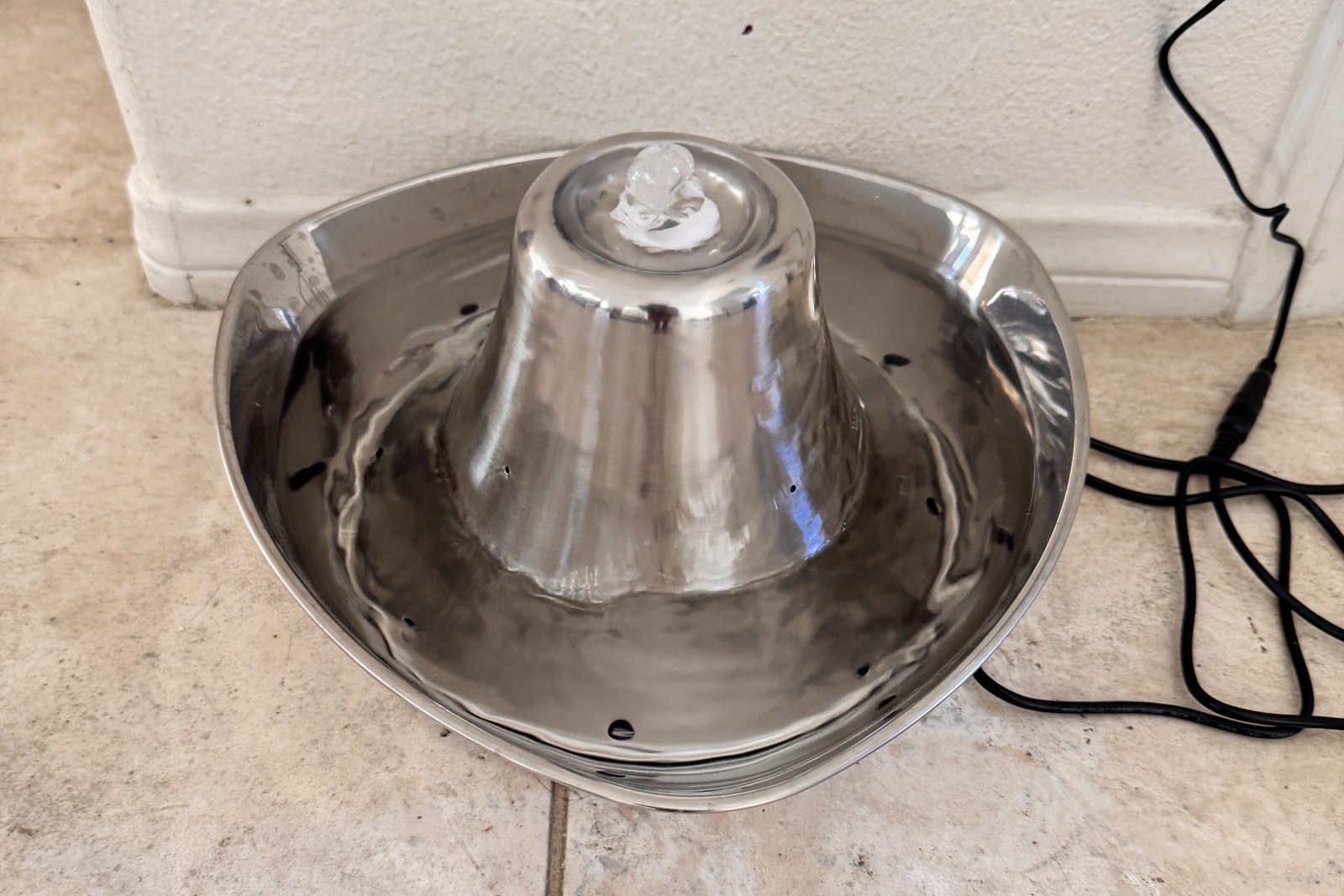
The fountain
A fountain does two things that a bowl cannot. Moving water stays cooler and reads as fresher to a cat, and the movement itself attracts attention from across a room, which is most of the effect. In a desert house the cooler part is not a small detail in July.
What a fountain costs you, since nobody puts this part in the list. It is a pump, so it runs continuously and it uses electricity, quietly and not much, but continuously. It needs taking apart and cleaning on a schedule, and in hard desert water it needs descaling more often than the manual suggests. Skipping that turns the thing you bought for freshness into the least fresh water in the house, which is worse than a bowl you rinse daily. A fountain is a commitment to maintenance, not a way out of one. That is why Planet scores medium rather than high on our Picks page.
Things that get recommended and did less than promised
Water flavored with tuna juice or broth works, in the sense that a cat will drink it. It also teaches a cat that plain water is the inferior option, and it adds salt. We treat it as a short-term tool for a cat who is genuinely not drinking, on a vet’s suggestion, rather than as a routine.
Ice cubes in the bowl are pleasant in summer and are not a hydration strategy.
Very wide bowls are often recommended so a cat’s whiskers do not touch the sides. Some cats clearly care. We could not tell a difference in ours, and we would rather say that than repeat the claim confidently.
The multi-cat version of the problem
Three cats change the shape of this in two ways.
You lose per-cat visibility. One fountain and one shared box means you know the household is drinking, not who is. Separate stations and separate boxes give some of that back.
And water becomes territory. A cat who is guarding a resource can quietly keep another cat away from the only interesting water source in the house, and it does not look like guarding, it looks like the other cat is not thirsty. More stations, in more rooms, is the fix, and it is the same answer as the litter box question.
Questions people have asked us
How much water does a cat need in a day?
The general figure used is roughly three and a half to four and a half ounces per five pounds of body weight per day, from all sources including food. The phrase that matters is “including food”, which is why the wet food change dominates everything else.
Will a fountain make my cat drink more?
Often, and for a plain reason: moving water attracts attention. It is a real improvement and it is smaller than switching to wet food. Both is best, and if you can only do one, do the food.
Is dry food bad for cats?
That is a bigger question than this post and it depends on the cat. What is not in dispute is that a cat eating only dry food has to make up a large water deficit by drinking, and most cats do not fully make it up. Talk to your vet about your cat rather than about cats.
My cat only drinks from the tap. Is that a problem?
It is a preference for moving, cool, fresh water, which is the same preference a fountain serves. It stops being charming if the tap is the only source the cat accepts and nobody is home to run it.
How often should I clean a fountain?
More often than you want to. Follow the manufacturer schedule as a floor, and add descaling if you live somewhere with hard water. A neglected fountain is worse than a clean bowl.
Where we landed
Wet food did most of it. More stations in more rooms did the next largest part. The fountain did the rest, and it earns its place, with a maintenance bill attached that we would rather state than leave you to discover.
More of what earned its place in our house, and what did not, is on our Practical Purrs Picks page.
What we use
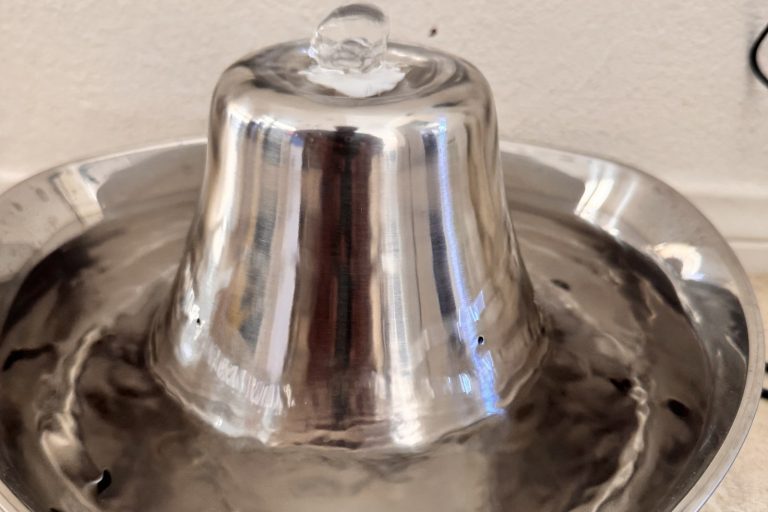
One simple open fountain, with a second coming, so there is always water in a bowl the cats can reach. PetSafe Seaside Stainless on Amazon · Why we stopped using our smart fountain · Everything we use for water
Your turn: what finally worked for your cat, and what did you buy that did not? Tell us in the comments.

2 Comments